




Analysis by Antonis Larentzakis
Service Pricing: Myths and Truths
In the world of business, service costing often resembles a “black box“: everyone believes they understand how it works, but few can truly explain what lies inside. Proper costing of a service is the foundation for sustainable growth in companies that rely on the time and skills of their people. Despite the common belief that the cost of a service roughly equals the employee’s salary divided by working hours, the reality is more complex. In practice, there are fixed costs (rent, utilities, support, training, management) that are not directly linked to projects but must be recovered through billing.
The aim of this article is to present a practical and theoretical framework that will help every service company calculate the true cost of labour and convert it into proper pricing.
Theory: Variable Cost, Fixed Cost and International Standards
To calculate the hourly charge for a service, you need to analyse two components: direct cost (labour cost plus training cost) and indirect cost (general administrative expenses not directly linked to revenue).
In our example, we assume that an employee theoretically works 1,720 hours per year (net hours after public holidays and leave). The direct cost per hour is derived by dividing the annual payroll cost by the productive hours. Indirect cost is allocated equally among those performing project work and then also divided by the hours. This approach captures the contribution of overheads to the final cost of a service and debunks the myth that “salary alone is enough.”
- The total cost of a service is split into direct expenses (VC) and indirect expenses (FC).
- Direct expenses depend on working time (salaries, contributions, benefits).
- Indirect expenses remain fixed regardless of hours (rent, technology infrastructure, administrative support).
- The full absorption costing method (absorption costing) allocates all costs, including fixed ones, to labour hours.

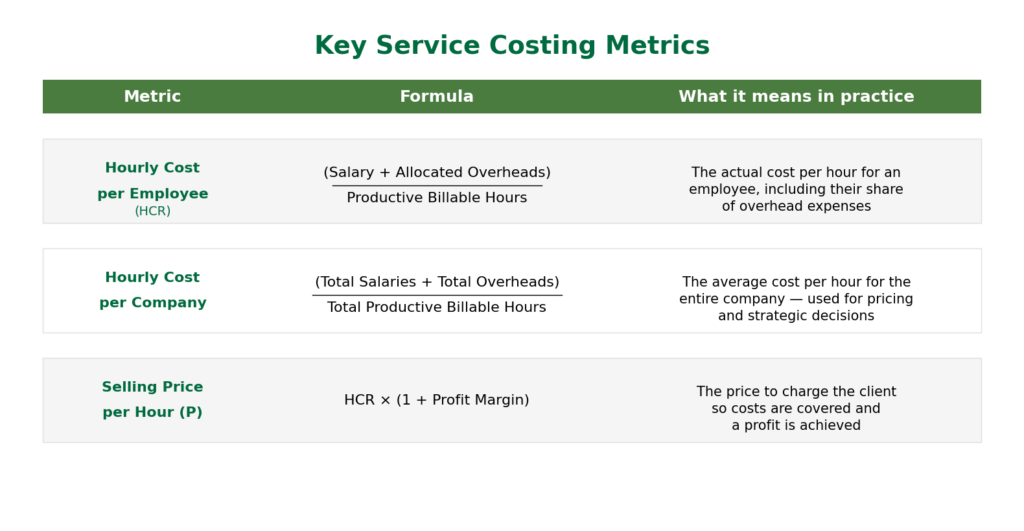
- If the HCR is €30/hour and we want a 20% pre-tax profit margin → price = €36/hour
- If we do not correctly calculate indirect costs → the margin (margin) vanishes without management realising it.
- Companies must also account in indirect costs for provisions (staff severance, doubtful clients, contingent general and tax risks), replacement of fixed equipment, consumables, financial expenses, and generally all operating costs a company incurs.
Practical Example of a 10-Person Company
Let us assume a consulting company with 10 professionals who generate revenue from preparing studies: 3 people with an annual salary of €25,000, 3 people with €35,000, 2 people with €50,000, one with €70,000 and one with €100,000. The total annual salaries of the professionals amount to €450,000. The annual indirect cost (rent, operating expenses, support, administrative staff payroll) is €100,000 and is allocated across 10 people (€10,000 per person). Note that indirect cost also includes the total payroll cost of support staff who do not directly generate revenue, such as: Secretariat, HR Department, Accounting, Field and miscellaneous staff, etc.
Using the theoretical 1,720 hours, the following table shows the direct, indirect and total cost per hour for each employee.
Table 1: Hourly Cost by Salary Category (€/hour)
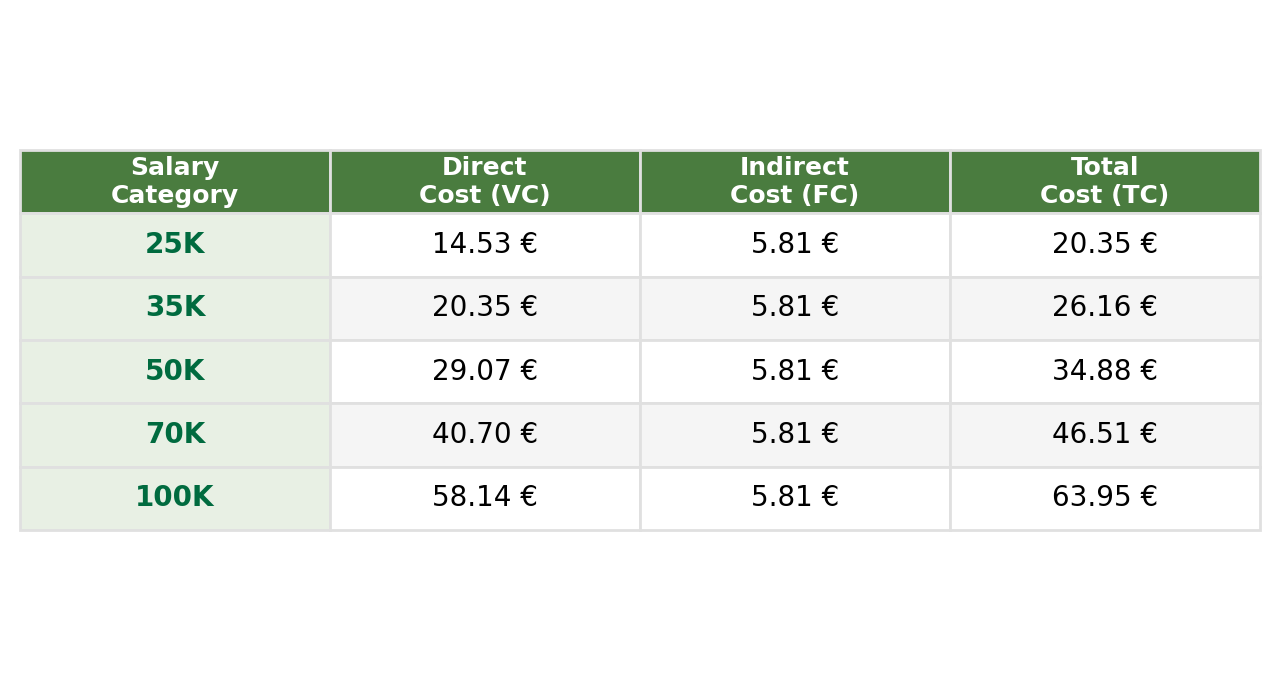
Chart 1: Hourly Cost by Salary Category
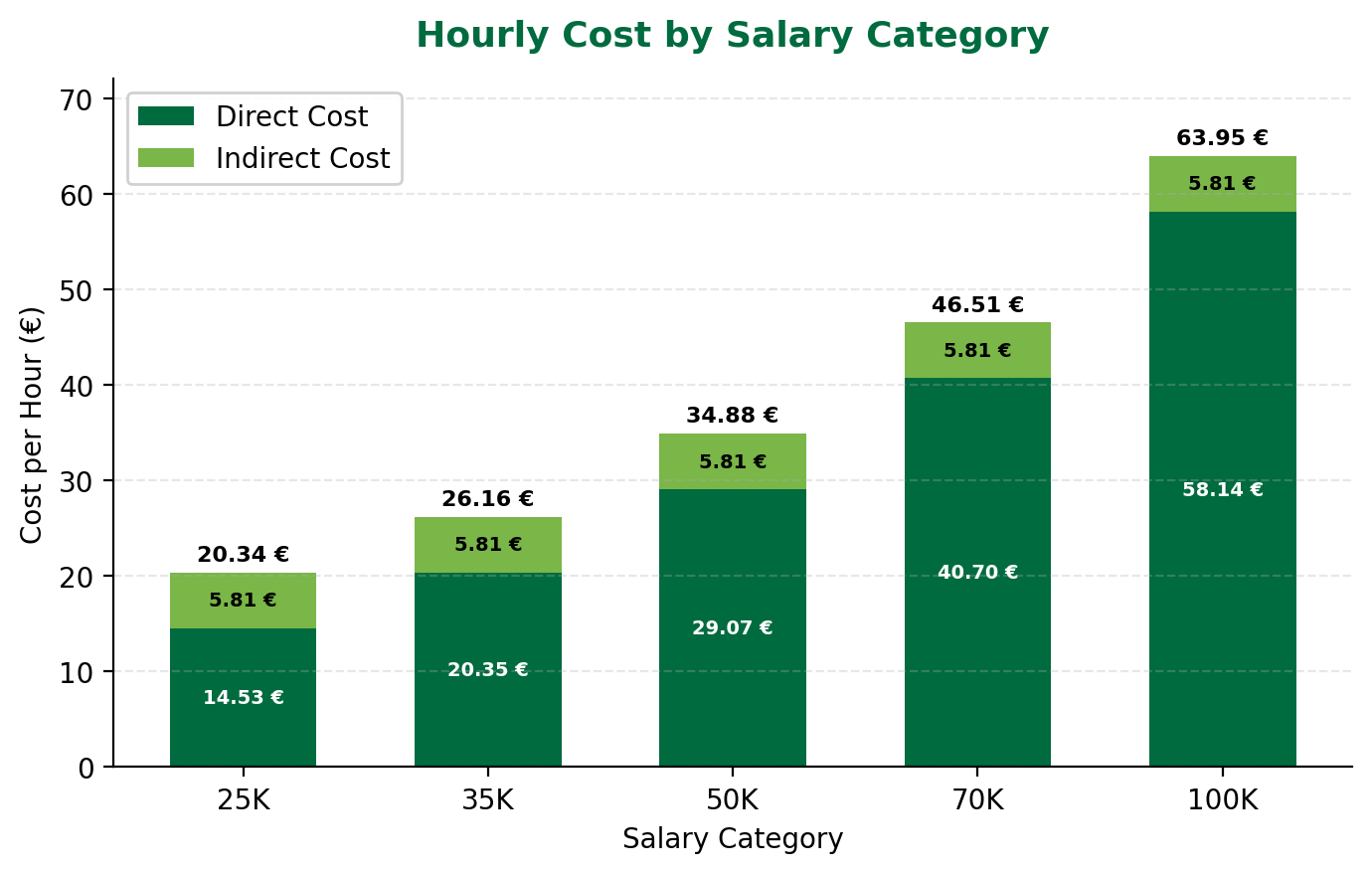
Chart 2: Average Hourly Cost in Theoretical and Actual Hours
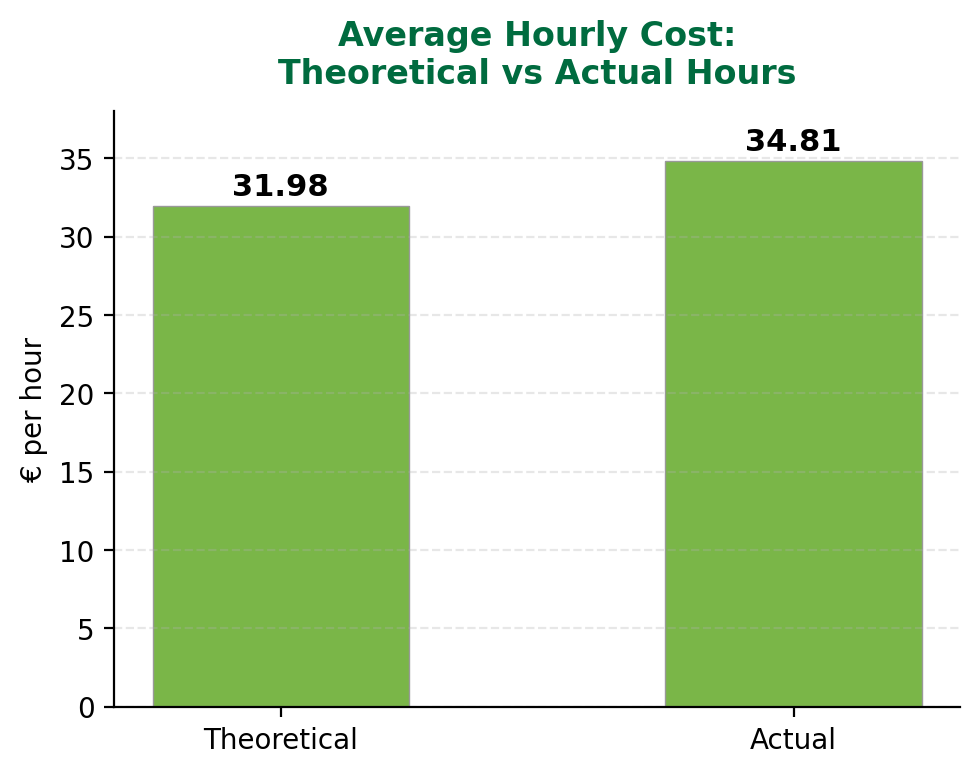
Theoretical hours are the standard 1,720 hours and actual hours are those ultimately realised during the year on a retrospective basis (approximately 1,500 hours).
Financial Analysis and Break-Even Point (Break‑Even)
- Total cost is defined as TC = VC + FC, while total revenue is TR = P × Q (P: price per hour, Q: billable hours).
- The break-even point is reached when revenue equals total cost: P × Q = FC + VC × Q.
- From the equation we get Q = FC / (P – VC). In our example, this equates to approximately 8,190 hours, e. 47.6 % of the annual available capacity of the 10 people.
Table 2: Break-Even Summary and Scenarios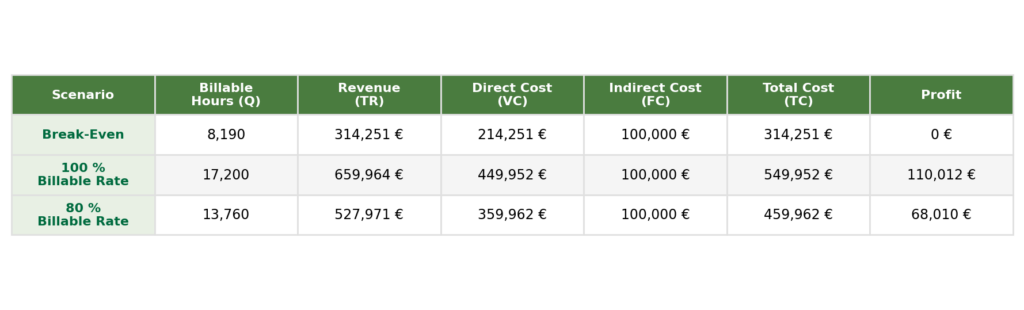
When we bill 100% of hours we earn a profit of 110,000 euros; when we bill 80% of total available hours we earn a profit of 68,000 euros. The minimum billing hours to reach break-even are approximately 47% of total available hours.
Per-Project Analysis and the Golden “80/20 Rule”
Overall cost and profitability indicators are useful, but each project must be tracked individually. The unwritten 80/20 rule suggests that a small percentage of projects or clients generates most of the profits. Detailed tracking of hours by employee level on each project reveals loss-making activities and helps in negotiating better fees or exiting unprofitable engagements. Combining quantitative analysis with qualitative assessment, you can retain clients who add value and improve the billing rate of available hours.
Actual Hours, Composite Roles and Myths
In real life, productive hours rarely reach 1,720. Leave, illness, training, internal meetings and other internal processes subtract time from billable hours (chargeable hours). In many companies, the average reaches 1,580 hours in a good scenario.
If costs remain unchanged, the average hourly cost rises – in our example from €31.98 it reaches €34.81. This shows that even a small deviation in productive hours can “inflate” the final price. It is therefore a myth that “we lost one day, it doesn’t matter.” Moreover, senior employees often take on more administrative or commercial duties. Their ratio of billable hours is lower and their hourly cost increases. This must be taken into account when they participate in projects, so that cost estimates are not disproportionately burdened.
From Theory to Practical Pricing
What do all the above mean for pricing? The answer is simple:
- Calculate the total hourly cost (Direct + Indirect) for your team, based on actual hours.
- Set a profit margin according to the complexity and value of the service. If the hourly cost is €32, a reasonable charge could be €45–50 per hour to cover contingencies and ensure profitability.
- Track productive hours through timesheet systems to identify trends and adjust pricing.
- Keep the team informed: efficient use of time reduces costs and enables more competitive prices without affecting profitability.
Conclusions
Service costing is not rocket science – it is proper information and organisation. Salaries form the basis, but fixed costs and actual hours determine the precise cost. By avoiding the myth of the “cheap hour,” companies can offer fair proposals, protect their profit margins, and cultivate a relationship of trust with their clients. Knowledge is power – and that power is even more efficient when it is calculated correctly.
- Service costing requires a combination of accounting precision and financial analysis.
- The separation into direct and indirect expenses reveals the true cost of labour.
- The application of mathematical formulas and the use of the break-even point provide clear guidance for setting prices and margins.
- Per-project analysis and the 80/20 strategy help companies focus on clients and projects with the greatest value.
- With this approach, pricing becomes fair, competitive and sustainable.