




Same profits, different picture. Welcome to IFRS 18 “Presentation and Disclosure in Financial Statements”!
In accounting, we are used to saying that the numbers speak for themselves. With IFRS 18, however, the way in which they tell their story also takes on particular importance. The new Standard does not change a company’s bottom line, but it redefines how its financial performance is presented. And, as with any good story, the right structure can make all the difference.
The application of IFRS 18 is one of the most significant changes of recent years in financial reporting under IFRS. The new Standard replaces IAS 1 “Presentation of Financial Statements” and is mandatorily effective for annual reporting periods beginning on or after 1 January 2027, with earlier application permitted.
Although IFRS 18 does not change how items in the financial statements are recognised and measured, it substantially changes the way in which companies present and communicate their financial performance.
For companies, therefore, the transition to IFRS 18 is not merely a compliance exercise. It requires a timely assessment of the impact on the financial statements, KPIs, management reports, alternative performance measures and, potentially, information systems and financial reporting processes.
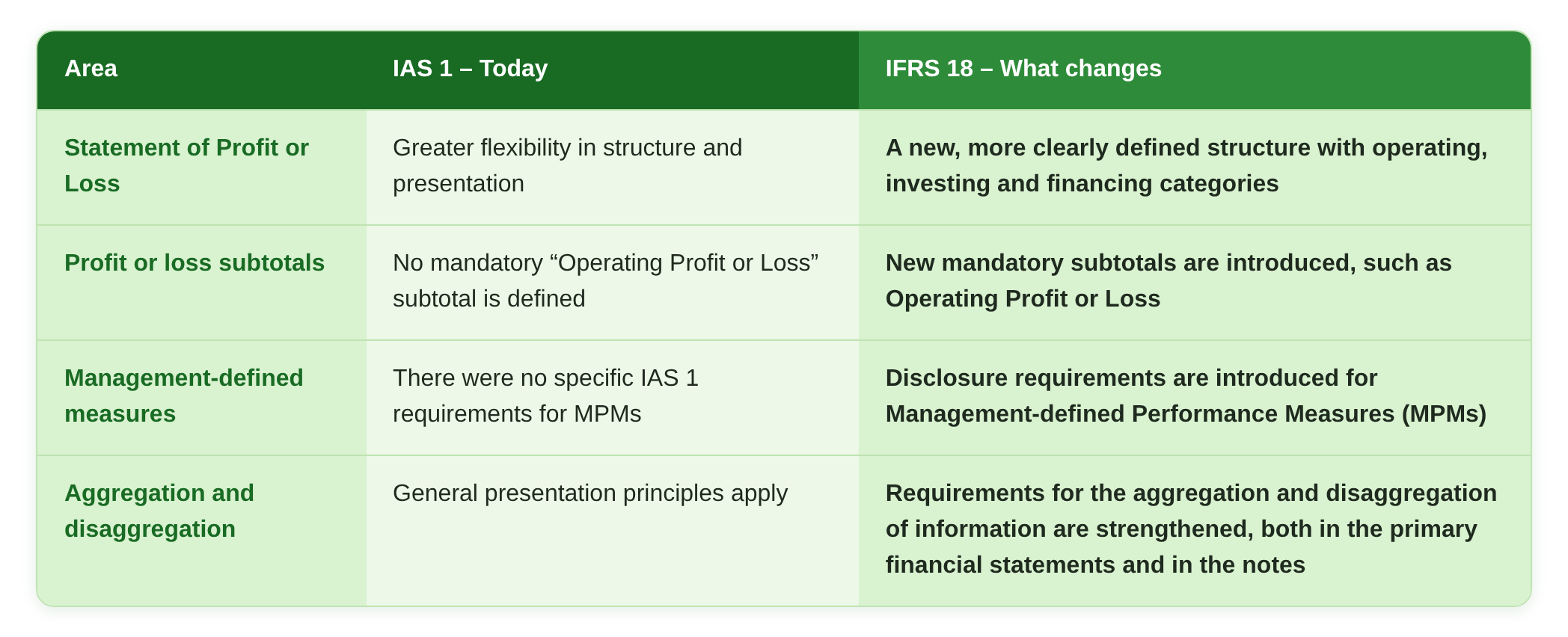
At a glance: What changes from IAS 1 to IFRS 18?
A new structure for the Statement of Profit or Loss
One of the most significant changes introduced by IFRS 18 concerns the structure of the Statement of Profit or Loss.
Income and expenses are classified into five categories: operating, investing, financing, income taxes and discontinued operations. At the same time, specific mandatory subtotals are introduced, most notably Operating Profit or Loss and Profit or Loss before Financing and Income Taxes.
The aim is to enhance comparability between companies since, until now, companies with similar activities could use different structures and different definitions for key measures of their operating profitability.
Application, however, requires significant judgement. Companies for which investing in assets or providing financing to customers is a main business activity need to pay particular attention, as IFRS 18 sets out specific classification requirements for them.
Management-defined Performance Measures
A second significant change concerns Management-defined Performance Measures (MPMs).
Many companies currently use measures such as adjusted operating profit, adjusted EBITDA or other adjusted figures to communicate their financial performance to investors and other stakeholders.
Under IFRS 18, certain subtotals of income and expenses that are used in a company’s public communications and that communicate management’s view of aspects of its overall financial performance may constitute MPMs.
For MPMs within the scope of the Standard, specific disclosures are required in the financial statements, including how they are calculated and how they reconcile to the most directly comparable subtotal or total specified by IFRS.
This change significantly increases transparency around so-called “alternative performance measures” and brings into the formal financial reporting framework part of the information that, until now, was presented mainly in investor presentations, press releases and management reports.
Aggregation and Disaggregation of Financial Information
IFRS 18 also strengthens the principles for the aggregation and disaggregation of financial information.
Companies will need to reconsider which items are presented in the primary financial statements and which are disaggregated in the notes, so that the financial statements provide a useful and understandable picture without material information being obscured through excessive aggregation of dissimilar items.
The presentation of operating expenses also becomes particularly important, as the new framework requires companies to assess whether presentation by nature, by function or a combination of the two provides the most useful structured summary of their expenses.
Why preparation needs to start now?
Mandatory application from 2027 may give the impression that there is still plenty of time. In practice, however, IFRS 18 requires retrospective application, which means that companies must be able to present comparative information in accordance with the new requirements.
Moreover, the transition may have implications that go beyond statutory financial reporting. Key performance indicators (KPIs), budgeting and forecasting models, management reporting, investor communications, the chart of accounts, consolidation reporting packages and financial reporting systems may all need to be redesigned or adapted.
How can UHY Axon help?
The UHY Axon team, combining technical expertise in IFRS with experience in implementing complex financial reporting requirements, can support companies at every stage of the transition to IFRS 18.
Our approach may include:
- Diagnostic review and impact assessment of IFRS 18, mapping the differences between the current presentation of the financial statements and the new requirements of the Standard.
- Review of the Statement of Profit or Loss, including the classification of income and expenses into the new categories and the assessment of the required subtotals.
- Identification and assessment of Management-defined Performance Measures (MPMs), through a review of existing key performance indicators and management’s public communications.
- Gap analysis of the required disclosures, including the new requirements for the aggregation and disaggregation of financial information.
- Design of new financial statement templates and support in preparing the required comparative information.
- Assessment of the impact on processes, information systems and internal controls, so that the required information is produced consistently, completely and reliably.
- Training for accountants, finance teams and management, through workshops tailored to the specific circumstances of each business.
IFRS 18 does not change the last line of the Statement of Profit or Loss. It does, however, change several of the lines above it. So 2027 may seem a long way off, but anyone who has been involved in implementing a new accounting standard knows that time passes faster as the publication date of the financial statements approaches.
Analysis by Christos Antonopoulos, Managing Partner at UHY Axon Group and IFRS specialist.